Proof of Lie Article
Where does your clock start? The race between learning loops
If your clock starts when you see the attack, the best you can ever do is tie.
Proof of Lie · 2 of 5
On October 1, Microsoft's annual Digital Defense Report printed two numbers that belong side by side. The median time from a vulnerability's discovery in the wild to its weaponization has fallen to well below 24 hours. Enterprises can take 30 to 60 days to remediate critical external vulnerabilities. Three weeks earlier, Anthropic's threat report described a Russian espionage actor whose agents rebuilt its malware on their own whenever security products detected it, and warned that, at least in theory, capable adversaries can "close the loop," getting past detections faster than defenders can build and deploy them.
Put the first two numbers in a ratio and you get roughly one to thirty, against the defender. That is a back-of-envelope figure, not a measurement: the two numbers do not share a starting line. Which turns out to be the whole problem.
For thirty years the industry has timed defense with a stopwatch: mean time to detect, mean time to respond. Both put one side against a clock. Neither measures the thing that now decides the fight, which is your learning loop against the adversary's.
A loop has a rate; two loops have a ratio
When both sides own the same tools, the tools cancel. What is left is who turns experience into protection faster. Put the two loops side by side and you get a ratio I call the Learning Advantage Ratio. In its obvious form:
LAR = the adversary's time to adapt ÷ your time to protect.
Above 1, you are out-learning the adversary. Below 1, you are falling behind. That is the whole thesis in one line, and in this form it is also a trap.
The trap: where the clock starts
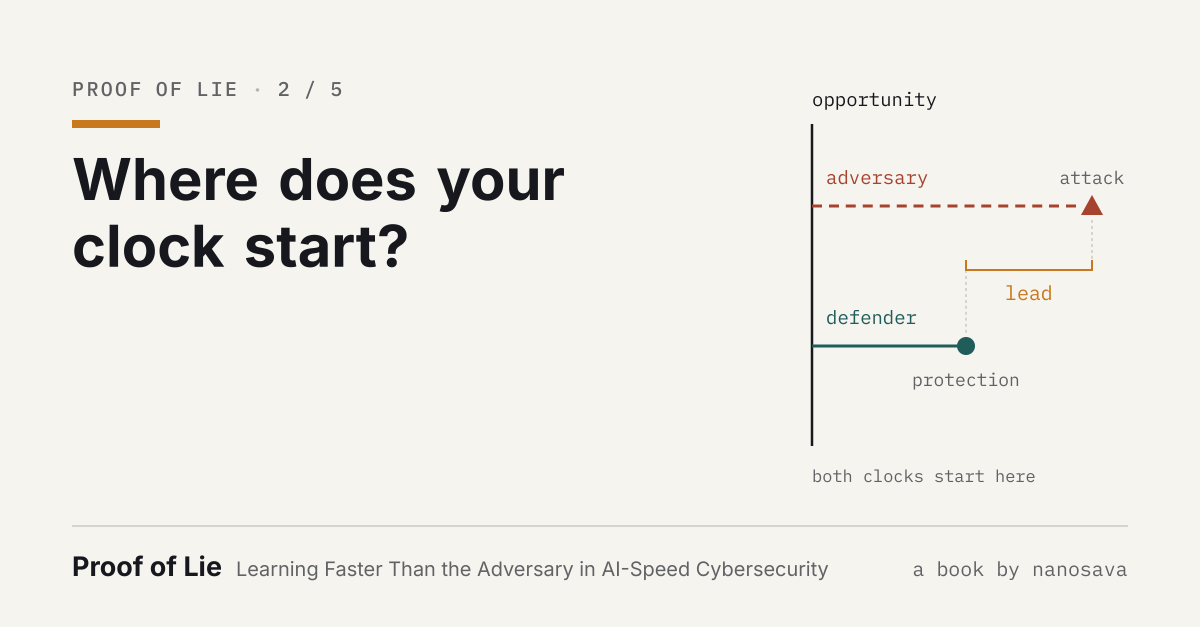
The obvious version starts your clock when you see the attack. Start it there and the adversary has already reached the surface first, so the best you can do, patching instantly and perfectly, is tie. Reactive defense has a ceiling, and the ceiling is 1. You cannot get far ahead of someone by responding to them.
So move the origin. Start both clocks at the birth of an opportunity: a new surface, a newly delegated authority to an agent, an integration, a configuration change, a model update. Anything that alters what can be exploited. Measured from there:
LAR = the adversary's time to turn the opportunity into a working attack ÷ your time to neutralize it with protection that holds.
Now the ratio measures something else entirely: whether you can see the opportunity the way the adversary sees it, before the adversary has moved.
A worked example, with invented numbers
The numbers below are invented for arithmetic's sake; no field deployment produced them.
A vulnerability class is disclosed in a gateway component you run everywhere. Day zero, for both sides. The adversary takes four days to weaponize it. You see the first exploitation attempt on day four and ship a rule on day six. The stopwatch version calls that a win: four days for them, two for you, LAR = 2.
Restart both clocks at the disclosure. The rule shipped on day six, but a shipped rule is activity, not protection. Replay the variant you held back for validation and it walks straight past. The fix that actually blocks it, keeps legitimate work running, and reaches the whole estate lands on day ten. LAR = 4/10 = 0.4. The adversary owned the surface for six days. Ugly, and honestly ugly.
Now watch the number lie. Suppose the team had estimated, in house, that weaponizing this class takes three weeks, and reported 21/10 = 2.1. Nothing on the ground changed, and the number went from losing to winning. That claim is not adjusted; it is void. The adversary's clock has to come from what a calibrated, independent adversary actually did, never from the defender's imagination of one.
What would being ahead have looked like? A team whose model of its adversaries already ranked that component as the cheapest next move starts closing it at disclosure and has a validated control in place by day two, tested against variants an independent red team built, since none exist in the wild yet. LAR = 4/2 = 2. The same 2 the stopwatch handed out for free, earned this time.
When the clock is allowed to stop
The defender's clock stops on validated protection, and only then. Four tests, all required:
- It blocks: remove it and the harm comes back.
- It generalizes: it stops variants you deliberately held back, not just the sample you saw.
- It preserves operations: legitimate work keeps running. A defense driven to refuse real work has lost while its dashboards stay green.
- It covers: the part of the environment that matters, not the lab.
A written rule, a closed ticket, and a detection are not on the list.
The industry got a vivid reminder of why in early October, when Google paused its open-source bug bounty, citing a surge of automated submissions, "the vast majority of which are not valid." Findings are cheap now. Validated ones are not. A clock that stops on the finding is timing the cheap half of the work.
Two gut-checks for Monday
- For your last ten incidents, when did the clock actually stop? If you marked them resolved when a rule was generated, rather than when it blocked a held-back variant without breaking operations, you have been timing theater.
- Name the opportunity each clock started from. If the honest answer is "when we saw the attack," your ceiling is a tie.
This week's ask: one clock
Pick one incident or one new surface from the last year and send me three timestamps, anonymized:
- When the opportunity was born.
- When an adversary weaponized it, and how you know: your own telemetry, an independent red team, or your own estimate (say which; the book treats them very differently).
- When validated protection held, by the four tests above.
If you cannot fill in one of the three, send that too. The blank is the finding.
Cannot share timestamps at all? Run the cheapest test in the book instead: hand the same campaign logs to two people, separately, and ask each to mark when the clock started and stopped. Tell me whether they agreed. If two of your own people disagree, you have opinions, not measurements, and that is worth knowing before anyone puts the number on a slide.
Send it as a comment below (free subscribers can comment), or privately to ping@proofoflie.com. Anonymous is fine.
The full measurement, with its voiding rules and a layer-by-layer version, is Chapters 2 and 5 of Proof of Lie.
The book is out December 1. Subscribe below for the next ideas, and for word the day it ships.
Sources
- Microsoft Digital Defense Report 2026, 2026-10-01, https://www.microsoft.com/en-us/security/security-insider/threat-landscape/2026-digital-defense-report: the "median time from vulnerability discovery in the wild to weaponization has fallen to well below 24 hours" and "Enterprise remediation for critical external vulnerabilities, meanwhile, can take 30 to 60 days."
- Anthropic, "Countering misuse of AI: September 2026," 2026-09-10, https://www.anthropic.com/threat-intelligence-report-september-2026: GTG-20006, a Russian espionage actor whose attribution Anthropic calls "consistent with public reporting linking the actor to Midnight Blizzard," used agents that rebuilt its malware whenever it was detected; "Now, at least in theory, capable adversaries can 'close the loop,' bypassing traditional security detections faster than defenders can develop and deploy them." Sep 10 to Oct 1 is the "three weeks earlier."
- Google OSS VRP pause: Google VRP on X, https://x.com/googlevrp/status/2105689195180179605, and BleepingComputer, 2026-10-05, https://www.bleepingcomputer.com/news/google/google-halts-open-source-bug-bounty-program-amid-ai-spam-surge/, quoting Google: product-vulnerability submissions "temporarily paused" because of "a significant rise in automated submissions, the vast majority of which are not valid"; an update is promised for Q1 2027.